
Dew on the grass
On being at home in the world, and its opposites

I do not, and will never, use AI in my work. What you read or hear, in all its frailty, comes from a human heart and mind.
****Audio Version
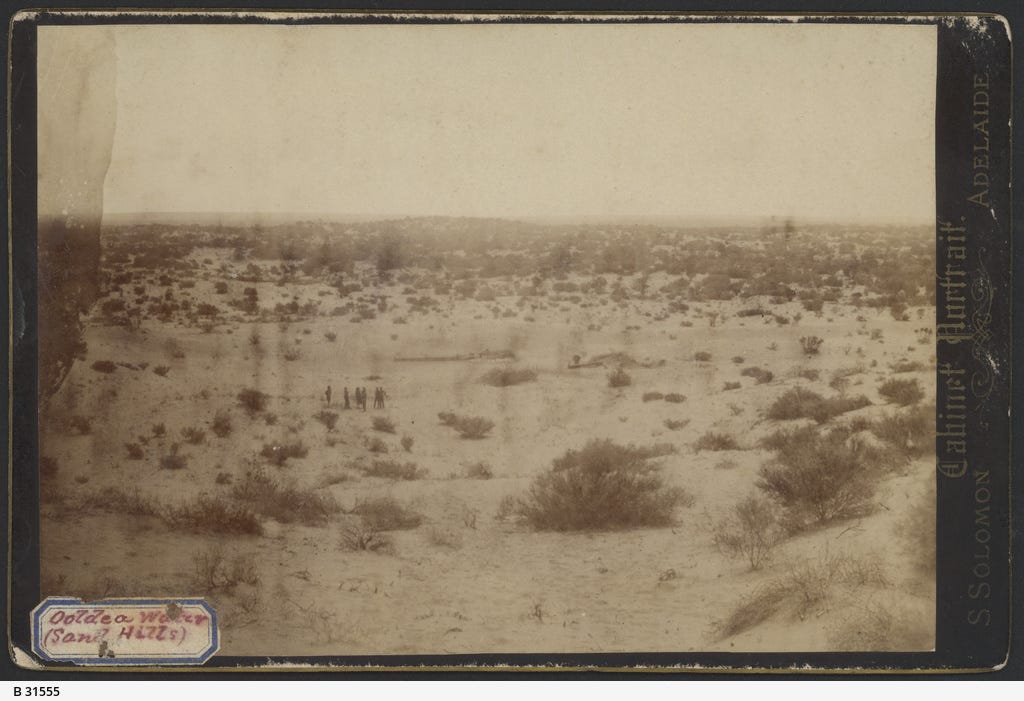
One winter about ninety years ago, two Pitjantjatjara girls of about 14 felt homesick. They were living in an encampment called Ooldea beside the Trans-Australian Railway line, on the edge of the Nullabor Plain, about 800 kilometres west of Port Augusta.
The girls wanted to see their family who lived about 800km to the north, at the Ernabella Mission, nestled in the beautiful Musgrave Ranges. There were no roads. Just desert. The same desert that the British Government decided was empty and worthless enough to use as a site to test a nuclear bomb in the 1950’s and ‘60’s. The girls took their few essential items – digging stick, firestick and coolamon, and probably dressed in clean but hand-me-down mission dresses, they set off, bare black feet on the red sand1.
A month or two later, the girls walked into the Ernabella Mission, none the worse for their journey. How had they travelled? Did they come on the Railway to Oodnadatta? No, they walked across the desert. So they knew all the rockholes across that wide stretch of ‘empty’ land? No, they did not know the rockholes, though members of their family surely did. The girls had simply woken early in the frosty dawn, and shaken dew from the grasses into their coolamon. Enough to survive. Enough to travel halfway across the continent. Every day, just enough to live that day.
How does that feel to your modern mind? Was it brave? Reckless? Stupid? Can you imagine yourself in their place? Digging stick in hand, and a coolamon tucked under your arm, no backpack full of freeze-dried meals, no swag or sleeping bag, no water bottle, and no camel to carry all the stuff you don’t have. Cold nights sleeping between fires, sheltered from the wind by a yuu, a half circle of leafy branches. Tomorrow’s food you will find tomorrow, gathering kampurarpa2 in these sandhills, or digging maku (witchetty grubs) from the roots of these ilykuwara3 . Sometimes a rough damper of toasted wanganu4 rubbed from those wiry tussock grasses that grow in sheltered glades between the wintalyka5, the seed ground on a tjiwa (grindstone groove worn into a desert rock by your ancestors this past thousand generations). Perhaps a sand goanna every now and then if the day is warm, or a small marsupial knocked down with a good throw and cooked in its skin on glowing coals as the night chilled down. Tomorrow’s water you will gather tomorrow, shaken cold from early morning grass.
Drink deep, then walk. But not a pressured anxious walk, no. An easy comfortable, watchful walk. Awake to the country at every level. Watching for tracks, for signs. Eyes out for food. What are the birds telling you? Remembering stories that tell the way. Remembering stories that tell of who you are and where you come from and why this land will care for you.
Oh, fellow modern! Can you imagine that? How much have we lost that such exploits - such quotidian exploits – are not just beyond our capability, but beyond our imagination. It is one thing to have lost the physical fitness and technical knowledge of the land that would make such a journey possible, but to me, the real tragedy is that we have lost the trust. We have fallen out of a covenant with the world. A covenant that said: “If you love me, and study me and learn my songs and move through me as part of my sacred unfolding, then I will provide for you. And if not today, then tomorrow. And if I let you die, and one day I will, it is not because I failed you, but because I am calling you back into my bosom”.
We cannot abide that she will take us. We no longer believe in that generous embrace that awaits us. We see annihilation, extinguishment, end. We build houses to shield us from the cold; we fit air conditioners to shield us from the heat; we put money away in investments to provide for our decrepitude; we build clever tools to make our lives easy; we dig up mountains to feed our machines; we cut forests to make room for our crops that will ensure we never go hungry; we build armies to make sure it can never be taken from us. We tell lies to make ourselves believe.
“The only true sense of security is a false sense of security”. Michael Meade
Security is a blanket. A blanket that keeps us warm and cosy, even as it suffocates us. Life fades under that blanket. The relationship between life and risk, life and death, is as that between light and dark. Each deepens the other.
We moderns are obsessed with ourselves, and yet, in “the individual”, we have constructed a hard, small and bleak container for our ‘self’. The individual is a consciousness that cannot be further divided6: we have jealously carved it away from all else, turning away each other, the world and the sacred as ‘other’. Detached, we cannot receive the bounty of the world, we cannot see the world in all its glorious awareness, in all its loving intent. We cannot participate in the world. We see only stuff. Stuff for us to use. And lonely, desperately lonely, we gather to ourselves every glittering nothing we can reach, and sooth our raw pain with cheap imitations of love.
Our self is a citadel, aloof and alone, looking out over a landscape that is foreign to us. Our two girls did not experience themselves and the world this way. They walked together. Knew each other’s thoughts. Dreamt dreams that came from the land itself. They knew themselves as part of every tree and hill and dry watercourse. They knew themselves as integral to that very landscape, not just at the surface level, but in every deepening layer to its very source.
Our girls lived in a living world, part of a living world. A world that their ancestors, and they themselves held responsibility for. A world which held them, but also required their presence, care and voice to persist and renew. The Dreaming gave story and song, and story and song was what lifted the world out of the murk, fresh, and dripping with dew. What do we moderns have? A dead world garlanded with exquisite, accidental beauty. A cache of resources to exploit for our share portfolios and future security. That security wherein you die one day, alone and empty, having never lived. A quest for ‘knowledge’ that we can prove but not feel. That we can monetise. Knowledge that will give us control over things that we must never control. Knowledge that will dissolve the need for meaning, for love. Knowledge that will seem to free us from the ‘curse’ of death, even as it robs us of life. Knowledge that must, in the end, corrode our very inner being as it corrodes our outer being, the World.
Our girls walked with the simplest tools. Pieces of wood. The digging stick, red-brown mulga wood, hardened in the fire and then ground to a sharp edge on one end. The coolamon, they called a piti, fashioned from the root of a redgum, the hollow dug out chip by chip using a mulga-wood adze armed with a blade of quartz like an old tooth. They did not need anything else. The tools they carried were not just adequate. They were conferred. Technology identical to that which the Dreaming ancestors carried. Sacred technology that it is for no human to replace or improve. This is what was given. This is what gave them their place. This is also what kept them in their place. But we moderns? We have progress: a restless urge to more and better and faster and shinier. A restless urge for new. New things, new places, new horizons, new ways of destroying everything we love. Progress does not have an end point. It does not have a limit. Progress must progress until there is nowhere else to go, nothing else to consume. Everything must keep getting better until all is dead.
You are not going to change. I am not going to change. That is our tragedy. We tell ourselves that our lives are normal, better, that there is no alternative. We prefer comfort and certainty to that terrifying foreign notion of trust. In turning away from change, you, we, are condemning our world to wither. A future denied to our children, a truly soulful, connected life denied to ourselves because we prefer convenience. Really. But maybe there is some magic to be sung up in the story of those two girls? Some deep alchemy of the Dreaming can enter our own dreams and rub a new tjiwa groove into the stone of our hearts? Maybe we can walk out into the ‘trackless desert’ beyond our selfish boundaries and live on the dew we can shake each morning from the grass? Let those girls walk through your soul this night and every night, and understand at least, what you have lost.
I don’t remember for sure where I heard this story. I think it might have been from the work of Anthropologist Annette Hamilton.
Solanum centrale
Acacia kempeana
Eragrostis eriopida (A relative of Teff)
Acacia aneura
Though the Internal Family Systems people would beg to differ.
This piece has filled me with a concoction of humbleness, sadness, dread and fear.... in a way that I want to hold on to in order to stay humble in this modernity city-dwelt life I have. The city makes you forget that which you have lost ... it's done on purpose to keep us all dependent on the security and delusion of city convenience.
Beautifully written, very moving. Thank you.