
There Be Dragons
Geo-Engineering

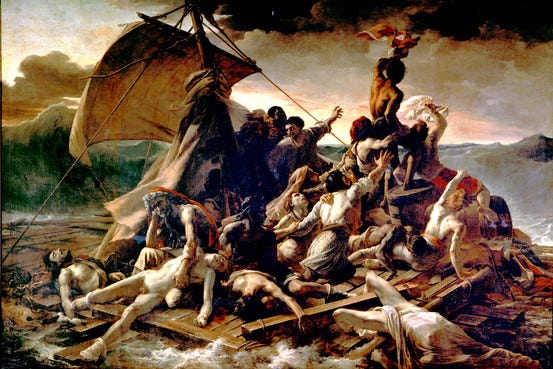
The Raft of the Medusa, Théodore Géricault
***Audio Version***
What are we to do? Oh, how I wish we could rewind and ask that question thirty years ago with the knowledge and urgency we ask it now. The population has grown by 1.6 billion in that time. Forests have shrunk by 177.5 million hectares. Atmospheric CO2 has increased by 20%.
I imagine myself on board a ship, sailing boldly, arrogantly, into the unknown. We passengers sometimes huddle in some shaded nook, enveloped in the sounds of creaking wood and the occasional snap of a sail and wonder darkly what perils lie ahead. Sometimes we fancy we hear the groans and cries of someone - galley slaves? - below us. Wretched bodies driving this hulk forward with sweat and strained muscle. Its not true. They told us its not true. Some of us know more than others, but all are increasingly uneasy. Some of the lowlier crew are starting to glance meaningfully at the water, and at the horizon ahead. We hear mutterings. The birds are flying backwards. But the officers are supremely confident. So confident you would think that they had a map.
Back in the bad-old-days, when the world might have been flat, and when, if you sailed too far and too boldly, you might fall off the edge, it must have been like this. Always searching the horizon for the fateful edge, the edge that you would only see once it was too late to turn back, when the flood of water cascading over the edge would carry you with it into oblivion. Some of us are starting to wonder. And as impossible as it is to put your finger on it, it is hard to escape the idea that the ship is speeding up, that the water is speeding up and driving us onward - to where? To an edge. To a precipice.
But ships are also vulnerable to more earthly things. Hard things.
Rocks.
Shoals.
And the world is clearly round, for the dark rocks and looming cliffs when we see them, rise top-first from a horizon. The crew look a little perturbed, but guide the ship onward anyway. They set the sails for more speed, and study the water, trying to divine who-knows-what? Do they not seem to see these glowering threats, some of them towering above our puny masts? They see them. But as soon as we squeak past-this-or-that peril, it is as though it never was. They laugh and jeer at out frightened faces.
Someone finally said it out loud yesterday:
“They are mad. They don’t know what they are doing”. Odysseus sailing between Scylla and Charybdis.
Monster or whirlpool? Which is to be our fate? The crew argue, pointing this way or that. We passengers nervously suggest that perhaps we might turn back? No-one hears, or at least, no-one listens. We ask again, and the officers offer us only monsters or whirlpools.
“This is what you want”, they tell us. “Listen, can any of you people handle a ship?”
This is not what we want. It is not what we want, though still we all spend our days scanning the horizon ahead, seeking for the safe channel that our careering vessel might squeak through, to some imagined safety. Oh, so far away. The way before us however, seems ever more perilous. It is true that we don’t want our ship to fetch up against one of those rocks with its surging garland of white foam, and we all fear monsters and whirlpools, so for what it’s worth, we project our attention, our hopes, forward, as if the intensity of our minds might move the rocks apart just enough to grant us a passage that costs no more than a scrape of paint.
Would that we were not on this ship. Would that the captain were not a reckless fool. Would that we had the courage and the means to mutiny and turn this thing around. The Officers tell us that we can’t go back. They laugh, and trim the sails for greater speed. “You wouldn’t like it anyway”, they tell us. “You can’t go back. You are escaping. Have you forgotten?” Yes, escaping. Our present, our past. The ship of emancipation. Yes, we all wanted emancipation from a brutal past. And it all looked so exciting! But they never told us the price.
Thirty years ago, had we known with the certainty and intensity that we now know, we might have taken a different path. We might have been able, in our ones and twos, in our families or communities, to step off that ship, until there was no ship, until there was no crew, until, the captain was no more than a pompous, irrelevant fool.
But now, crowded around with rock and tipping points, surging recklessly into a future many of us believe will be no future, we need to make a choice. We have before us but the most rudimentary of maps, and from this dubious sketch, where the only known safety is marked with dragons, we have to make impossible choices. And we have to make them decisively and in sufficient numbers to carry the day. And if I’ve given the impression that most of us passengers are muttering and plotting, I was wrong. Most of us are oblivious, complacently trusting this (obviously) maniacal crew. Many will not start to wonder even when they feel jagged rock gouging our flimsy keel.
The problem, quite simply, is that it may be, it probably is, too late to get off this crazy ship. This Ship of Fools. Too late to turn it around.
So to leave the allegory behind somewhat, (because I’m not sure it can take us much further and it might have just been a ploy to delay me writing about some things that I’m very uncomfortable about), we have a deepening climate crisis, and more other crises than I care to think about surging up behind it like giant swells that rise and propel our foundering craft upon a hostile foaming shoreline. A vision to strike terror into any sailor’s heart. But for now, the climate crisis is quite enough. We might sum the problem up thus:
1. Our leaders (globally) have no intention of doing anything meaningful to solve the problem.
2. Our leaders are incapable of doing anything meaningful to solve the problem.
3. We want to be comfortable and wealthy more than we want our children and our planet to survive and thrive. Sad but, apparently true. If our leaders were to try to do something meaningful, we would vote them out. (See no. 2 )
4. Powerful forces oppose any action. Because they don’t believe. Or because they can’t bear the idea that they have to stop their pillage before there is nothing more to pillage. Or because they can’t bear the idea of stopping before they have ‘enough’. Or because they believe that their wealth and power will insulate them from all the bad things that will affect everyone and everything else. Or because they believe that all this, messy as it will be, will rid them of we riff-raff and they will be able to found a New Empire of the Worthy. An Empire of Cavernous Greed. Or because they think that they will just flit off to Mars and make a better life for themselves. Or because they think they will just upload their consciousness to the cloud where climate is irrelevant. Or because technology. Or because delusion. Or because narcissism. Or because stupidity, cupidity or (is it really possible?) ignorance.
5. I don’t know where we are on our rudimentary map, but it doesn’t look good. Wherever we are, there will come a time (and it may well have passed already), when one or more critical tipping points has been breached, and catastrophic, runaway warming is locked in. A jagged rock punctures our fragile hull. “All hands to the pumps”. But we can’t pump fast enough, and the water steadily rises around our ankles.
6. At that point ‘the game may well be up’, quite possibly for all complex life on Earth. Without doubt we bequeath an increasingly difficult life to our descendants, many, many of whom will die in extreme weather events or famine that we have created in our complacent and indulgent lifetimes.
7. If we reach this point, the only way forward (were we to suddenly start to value the web-of-life around us) will be geo-engineering. Of course, we would reach this point even if we only cared about our own miserable lives. Or if we only cared about our comfort. The status quo. This objectively ludicrous sense we have of stability: We’re floating, we’re moving forward (whatever that means), and we are not going to mention the water around our ankles, or our knees.
Geo-engineering. That’s what this piece is about. Just to think about it feels like failure. But we have to. Perhaps so that we can oppose it vehemently. Perhaps so that we can ensure it is undertaken well and in time.
What might geo-engineering look like? The earth is absorbing more solar radiation than can escape into space. One estimate puts the amount at 5 zettajoules (that’s 5,000,000,000,000,000,000,000 joules) per year. Perhaps it makes more sense to say the equivalent of two Hiroshima bombs every second?
There are two broad approaches to geo-engineering: one is to capture and sequester CO2, the other is to reduce the amount of solar radiation reaching (or lingering on) the Earth’s surface by increasing reflectance.
On the first approach, I think it is fair to say that we have been unwittingly (witlessly) geoengineering the planet in the wrong direction for a hundred and fifty years – digging up and burning fossil carbon deposits and dumping their waste products into the atmosphere, but also cutting down forests and destroying soils through agriculture. We don’t seem to be able to stop burning fossil fuels, and we don’t seem to be able to stop cutting forests. And some yet-to-be-invented Big Machines are going to remove all that carbon from the air. Sure thing. Would you like to buy a bridge?
Geo-engineering approaches that seek to manage solar radiation levels seem more likely. These approaches include ideas such as reducing cirrus cloud (that has a blanketing effect), releasing reflective particles into the atmosphere to mimic the effects of volcanic eruptions, increasing reflectance by spraying sea water high into the air (which has the effect of brightening clouds), or brightening the oceans by injecting micro bubbles, or even just painting urban roofs white. Or there is the big one: the deployment of a huge reflective array in space to reflect away about two percent of the radiation that would otherwise reach the Earth. The sort of thing Elon Musk would love – but consider the risks: tech failure, solar storms, space junk impacts, political failure…or Elon Musk – the rise of mobster government in the World’s most powerful country (well that would never happen), economic collapse, war etc. In fact, this is just the type of thing a mobster government or a terrorist group would be tempted to use as an extortion tool. How would you and I, how would even a moderately wealthy and capable country ever hope to fix this thing if it went wrong?
It is not certain that any of this is feasible. The approaches that seek to reduce solar radiation reaching Earth’s surface might be able to slow or stop warming, and might therefore be able to prevent or delay some of the more catastrophic tipping points – by refreezing the arctic or restoring rainfall patterns in the Amazon, but they will not address the acidification of the oceans. Some of our carbon dioxide emissions dissolve in the oceans and thereby increase their acidity. In 200 years ocean acidity has increased by 30% . Beyond a certain point, ocean acidification will be catastrophic for complex life on our planet (See here, and here).
I don’t want to dwell much on these technologies. You can find a good summary of the potentials and issues here: https://www.carbonbrief.org/explainer-six-ideas-to-limit-global-warming-with-solar-geoengineering/
At a very deep level, I oppose geo-engineering. I’m not longer sure what I think about geo-engineering. There are a few reasons, not least that if we get to the point where we need such an intervention, then we have to wonder if we really deserve this Earth we were given. But OK, many, many, humans alive today played no part in creating this mess, and neither did any of the children yet to be born. “We” is not all humans. “We” is not all life on Earth. But, (sorry, dear reader), it almost certainly includes you and I.
I oppose geo-engineering I quake at the thought of geo-engineering because we would be playing with things that we don’t understand, and in all likelihood will not be able to control. We are tinkering with a massively complex system (which we have already thrown into disarray), and have little to no understanding of how this-or-that geo-engineering action will play out in the real world and across time. But then again, we are already doing that. The planet-as-we-know-it is dying as a result.
I oppose geo-engineering because it will be controlled by the powerful and as such it will serve primarily to enable the continuation of rapacious, extractive consumer societies. Geo-engineering invites us into complacency: allowing us to feel that everything will be alright, that we can continue in our profligate ways. It will extend the life of capitalism sure, but then we will crash headlong into the next crisis of our own making. There are many to choose from. Without the profound transformation of large chunks of humanity, geo-engineering is nothing more than self-serving hubris.
I oppose geo-engineering because it offers hope that is probably false. Even if we allow that it might be technically feasible, we would have to implement it on a global scale in a world that is demonstrably run by very bad, and very stupid people. The World order is in tatters, just when we would need unity such as we have never seen before. To be done well, or at all, geo-engineering would require a very unlikely global consensus and global governance (that at this time seem more distant than ever). Real leadership seems an impossible dream. Any implementation will be by the powerful for the powerful. The people who will decide to proceed with geo-engineering will be overwhelmingly white and male. (Perhaps they will be Chinese (and male?)) The poor farmers in the Sahel or the Indian farmers dependent on glacial meltwater for their livelihoods, the indigenous people in Australia or South America will figure not one jot in the calculation. It is hard to imagine poor communities figuring in any way in the targeting, implementation, monitoring and tweaking because the assumptive model of humanity for anyone in a (financial and technical) position to implement geo-engineering is WEIRD (Western, Educated, Industrialised, Rich, and Democratic). (Though perhaps not so much democratic these days?) Quite simply, we are not ready for such an undertaking and will not be until the billionaires and their enablers have been shown The Plank. Until such a time we would either be doing it too early and for the wrong reasons (to prolong the party), or for the right reasons, but far too late.
I oppose geo-engineering. I think that geo-engineering will ultimately fail because it misses the point: because it is futile to attempt to solve what is fundamentally a cultural problem with technology. The problem is that you and I want too much. We want to be warm, we want to be cool, we want shiny things. We want to be secure. It feels like the old rhyme about the “old woman who swallowed a fly. Perhaps she’ll die?” After a series of escalating interventions, each more absurd than the last, she does indeed die: “The was an old woman who swallowed a horse. She’s dead of course”. If you pursue technological answers to cultural problems, you will end up swallowing a horse.
I oppose geo-engineering. And yet, I can see that one day, not too far away, it might be the only hope left to us. To even countenance it feels like failure because such technologies, and such scale of implementation demand the maintenance of industrial society. The cure demands the continuation of the disease. Maybe that is inevitable anyway. Even if we did geo-engineer for humanity, this is simply not enough. It has to be for Life. We have to bow our heads and serve something bigger than ourselves. We are not separate.
We can safely assume that research into geo-engineering is accelerating, and as a last-ditch insurance policy, I suppose it should. Whilst I don’t doubt that at least some of the scientists and engineers working on these concepts are both well informed and well-intentioned, it is ultimately politicians and their (too often) shady backers that will decide what, how and when. And why. The why of it will inform every other aspect. It will decide what guide-rails should be in place, what monitoring, what compensations. What can be sacrificed.
So here we are. Barrelling along in our ship. There are no good choices before us. We don’t even really know where we are. We might sometimes imagine it’s just us that will pay the price (well, weren’t we a bit silly!) But it’s not. It’s the entire web of complex life that has evolved over billions of years that is at stake. That life will not be extinguished, but if we continue as we are, it could be reset to a ‘level’ analogous to what was around 540 million years ago. That’s quite a legacy for little us, with our tv’s, share-portfolios and two-car garages. (And don’t forget that the worst of that longer term damage will be caused by ocean acidification not atmospheric heating - CO2 emissions that we were able to keep pumping out because we brought heating under control).
We have to do something. It might be, (it almost certainly will be), that we have to geo-engineer. Please, let it be for the right reasons and in the right ways! But, dear readers, (all hundred or so of you), could we not do the hard work, do the transformative work, and find a new way of being in the world, a way that seeks harmony with all life, and purpose in being, being a part of, and loving that life? If we do not, then all the geo-engineering in the world will be for nought.
The debate around geo-engineering is significant. Find some technical details on climate changes and geo-engineering highlighting associated quandries in this perspective — https://genn.cc/david-spratt-1-5-degrees/